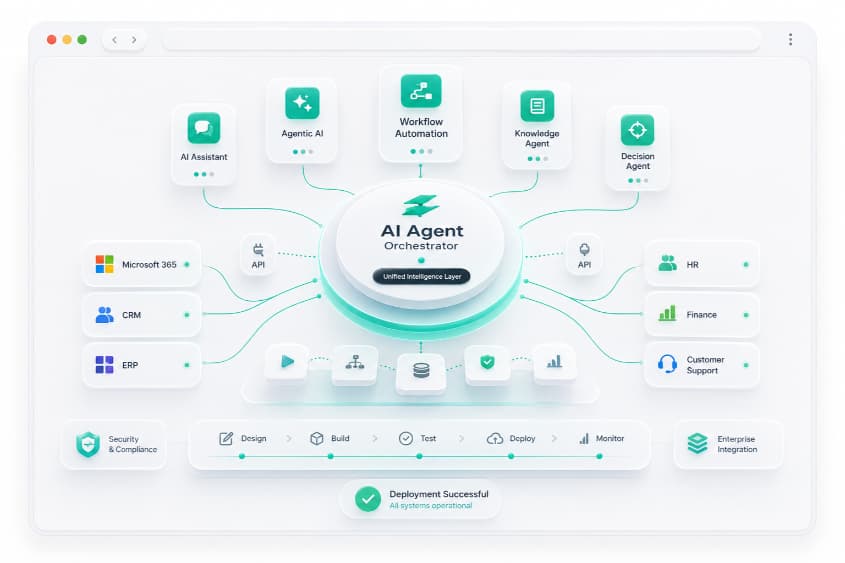
Agentic AI & Enterprise Integration Definitions
Synottic Insight BriefingSynottic bridges the gap between proof-of-concept and production by architecting custom AI Agents, RAG pipelines, and automated workflows that natively integrate with existing enterprise systems.
Key Enterprise Definitions
- Agentic AI
- Autonomous AI systems that don't just generate text, but take complex actions, use tools, and make decisions to execute multi-step workflows on behalf of users.
- Multi-Agent Systems
- Architectures where multiple specialized AI agents collaborate, negotiate, and share information to solve enterprise problems that are too complex for a single model.
- Retrieval-Augmented Generation (RAG)
- A technique that grounds Large Language Models in secure, proprietary enterprise data, ensuring generated answers are accurate, verifiable, and contextually aware without retraining the model.
Find My Solution Path
Answer four quick questions to find the right deployment approach for your business challenge.
What business problem are you solving?
Enterprise Solutions for Real Business Problems.
Every organization’s needs are different. We design and deploy the right AI solution to match your strategic goals, workflow complexity, and governance requirements.

Enterprise AI Assistants
Role-specific AI assistants that understand context, connect to enterprise knowledge, and support employee productivity safely.
Knowledge workers, customer support, sales teams
4-8 Weeks
Employees spend too much time searching for information or performing repetitive tasks.
Increased productivity, faster onboarding, reduced resolution times.
Custom AI Agents
Task-oriented agents that can use tools, retrieve information, and take action within defined enterprise boundaries.
Operations, finance, and specialized teams
8-12 Weeks
Complex tasks require integrating information across multiple systems to make decisions.
Process automation, reduced errors, scalable execution of complex workflows.
Multi-Agent Systems
Coordinated systems where specialized agents work together to solve complex, multi-step business problems.
Enterprise operations and complex workflow owners
12-16 Weeks
End-to-end processes require different specializations and cannot be solved by a single model.
End-to-end process transformation, scalable decision making, dynamic workflow orchestration.
Enterprise Knowledge Platforms
Unified AI platforms that connect disparate data sources into a secure, conversational knowledge interface.
Enterprise-wide deployment, knowledge management teams
10-14 Weeks
Organizational knowledge is siloed, outdated, and difficult to access.
Single source of truth, democratized knowledge access, preserved organizational intelligence.
Workflow Automation
Intelligent automation that combines AI capabilities with traditional enterprise workflow systems.
Process owners, IT, operations
6-10 Weeks
Manual processes create bottlenecks, errors, and scale limitations.
Straight-through processing, reduced operational costs, higher accuracy.
RAG & Enterprise Search
Advanced Retrieval-Augmented Generation systems for precise, grounded answers from enterprise documents.
Legal, compliance, research, and technical teams
8-12 Weeks
Standard search returns links, not answers. Generic AI hallucinates without enterprise context.
Accurate information retrieval, grounded answers with citations, reduced research time.
Custom LLM Solutions
Fine-tuned models and specialized LLM implementations for highly specific enterprise use cases.
Organizations with highly specialized terminology or tasks
12-20 Weeks
Off-the-shelf models fail to understand domain-specific nuances or formats.
Domain expertise captured in AI, high accuracy on specialized tasks, IP protection.

Deploy Enterprise AI Agents That
Deliver Real Business Outcomes.
Synottic designs the transformation. TableSprint accelerates enterprise deployment. Together they help organizations move from strategy to working AI systems faster.
Months of Custom Engineering
Building enterprise AI from scratch requires managing infrastructure, orchestration logic, vector databases, integration layers, and complex prompt chains before you even begin addressing the business problem.
Rapid Enterprise Deployment
Launch production-ready AI solutions without sacrificing governance, scalability, or enterprise integration. Focus entirely on the business workflow and user experience.
Enterprise Capabilities
Everything needed to run AI in production.
No-Code Agent Builder
Visually construct complex agentic workflows without writing code.
Workflow Orchestration
Manage state, human-in-the-loop approvals, and complex task chaining.
Enterprise Integrations
Connect natively to SAP, Salesforce, ServiceNow, and custom APIs.
Multi-Agent Coordination
Deploy swarms of specialized agents that collaborate to solve problems.
Security & Governance
Enforce strict role-based access, data privacy boundaries, and audit logging.
Monitoring & Analytics
Real-time visibility into agent performance, cost, and task success.
Business-First Use Cases
AI applied directly to enterprise value streams.
Customer Support Agent
High volume of repetitive tier-1 support tickets slowing down human agents.
Autonomous resolution of standard queries, seamless human escalation.
Internal Enterprise Copilot
Employees struggle to find cross-departmental information quickly.
Unified conversational interface securely connected to all internal knowledge.
Document Processing Pipeline
Manual data extraction from unstructured invoices and contracts.
Automated extraction, validation, and structured data entry into ERP systems.
Sales & Finance Assistant
Account executives spend hours gathering data for proposal generation.
Instant generation of customized proposals using CRM and product data.
How Enterprise AI Solutions Connect Together.
A production AI solution requires more than just an LLM. It requires an orchestrated architecture connecting users, agents, logic, and enterprise systems securely.

Business Users
Employees, Customers, Partners
AI Agents & Assistants
The interaction and execution layer tailored to specific roles
TableSprint Deployment Platform
The orchestration engine that manages workflows, state, API connections, and governance rules.
Enterprise AI Models
The reasoning and generation layer
Enterprise Systems
Where data lives and work happens
Make the Right Technology Decision.
Synottic acts as an independent advisor. We help you choose the simplest, most effective way to deploy AI based on your use case, existing infrastructure, and timeline.
Custom Development
Building directly on foundation models and cloud infrastructure (Azure, AWS, GCP) using frameworks like LangChain or AutoGen.
Highly specialized use cases requiring custom IP, unique algorithms, or extreme scale.
TableSprint Platform
Using an enterprise AI orchestration platform to rapidly build, connect, and govern AI agents without managing underlying infrastructure.
Rapid deployment, standard enterprise integrations, and strong governance are priorities.
Microsoft Copilot Studio
Extending Microsoft 365 Copilot with custom conversational agents anchored within the Microsoft ecosystem.
You are heavily invested in M365 and want agents to live entirely within Teams or SharePoint.
iPaaS (n8n, Zapier, Make)
Using traditional integration platforms enhanced with AI steps for deterministic, linear process automation.
Simple, rule-based workflows where AI just performs a single step (e.g., summarize an email).
The Journey from Strategy to Production.
Our structured delivery methodology ensures that AI solutions are not only built quickly, but deployed safely and adopted successfully.

Business Discovery
Define the problem, success metrics, and value hypothesis.
Solution Design
Map the Human+AI workflow and user journey.
Architecture
Design integration, security, and data architecture.
AI Agent Design
Configure agent roles, instructions, and tools.
Knowledge Integration
Connect enterprise knowledge and vector search.
Testing
Evaluate accuracy, hallucination, and guardrails.
Deployment
Launch to production environment.
Governance
Implement monitoring, logging, and access control.
Training
Enable users to adopt the new workflow.
Optimization
Measure value and refine performance continuously.
Enterprise Buyers Purchase Outcomes.
We deliver more than just working software. A Synottic deployment includes the architecture, governance, testing, and training required for enterprise operation.
Working AI Agent
A production-ready AI agent or multi-agent system deployed to your environment or enterprise platform.
Architecture Blueprint
Detailed technical documentation covering data flow, security boundaries, and enterprise integration points.
Prompt & Tool Library
Optimized system instructions, few-shot examples, and tool schemas designed for your specific use case.
Guardrails & Governance
Configured safety boundaries, PII redaction rules, and role-based access controls.
Testing & Evaluation Report
Comprehensive results from accuracy testing, hallucination checks, and security penetration.
Adoption Playbook
Training materials, user guides, and communication templates to drive employee adoption.
Curious to see what these deliverables look like in practice? We can walk you through sanitized examples during a discovery call.
Schedule Discovery Call →Connected to Where Work Happens.
AI is only as powerful as the systems it can access. We integrate AI capabilities securely into your existing enterprise architecture, respecting existing permissions and boundaries.
Deployment Is Part of a Larger Transformation.
The AI Solutions Lab represents the deployment engine of the Synottic platform. It connects directly with our strategy, governance, and scaling capabilities.
Grounded in Real Engagements
Every recommendation is shaped by work with real organizations, leaders, and teams — not theory.
See How Organizations Put This Into Practice
Explore transformation stories from enterprises building AI readiness, capability, and responsible adoption with Synottic.
Explore case studiesDifferentiate Through Delivery.
We approach AI deployment from a business-first perspective, ensuring that technology serves the strategy, not the other way around.
Questions Leaders Ask
Practical answers from real conversations with executive teams.