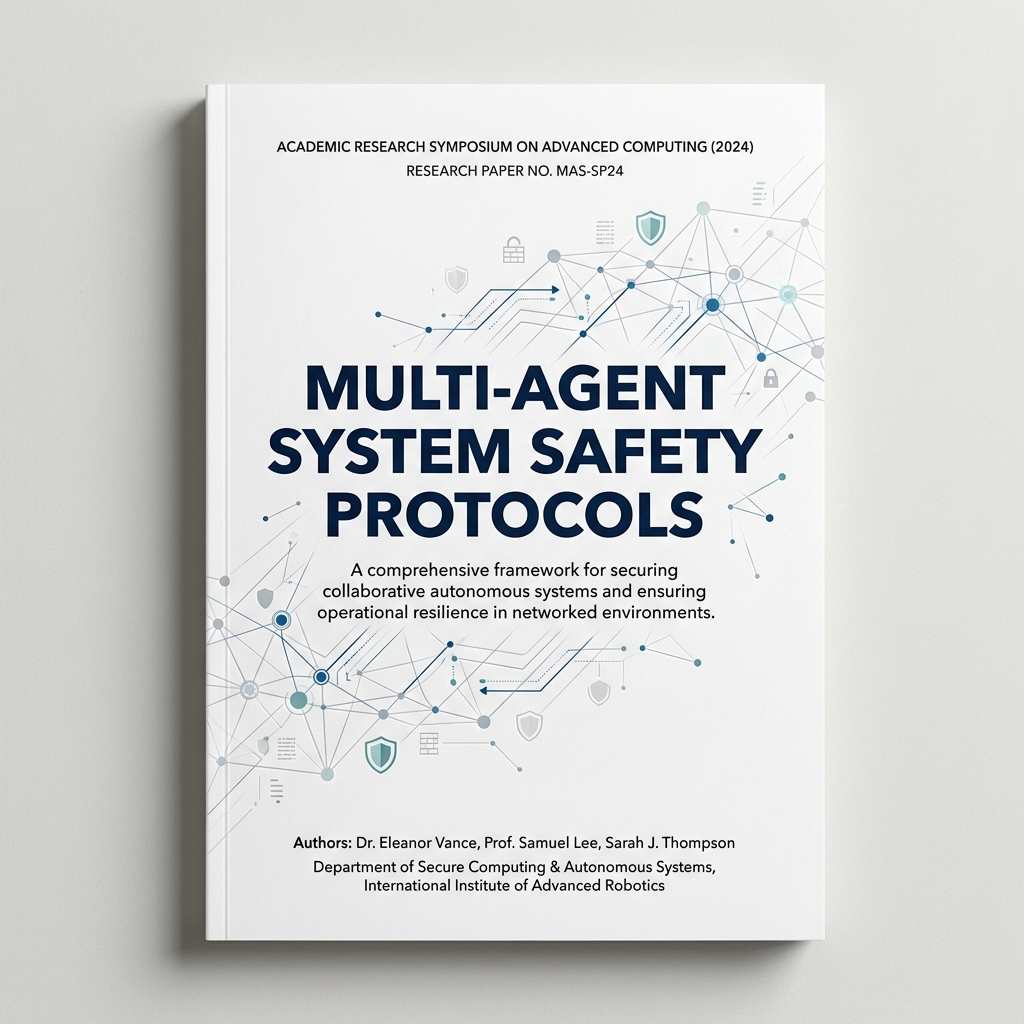
Multi-Agent System Safety Protocols
Guardrails, Alignment, and Regulatory Frameworks in High-Risk Environments
Executive Summary
The rapid integration of artificial intelligence into enterprise operations has precipitated a structural paradigm shift from single-prompt, stateless large language models (LLMs) to autonomous, multi-agent generative systems. These systems maintain state, collaborate through specialized roles, recursively retrieve information, and execute irreversible external actions via application programming interfaces (APIs) and tools.
However, this transition introduces profound safety, security, and governance challenges. When agents are granted the agency to act within high-risk environments—such as algorithmic financial trading, healthcare diagnostics, or critical infrastructure management—the impact of probabilistic errors, adversarial prompt injections, and misaligned behaviors becomes immediate and potentially catastrophic. Standard LLM safety mechanisms are structurally inadequate for multi-step agentic workflows where risks emerge dynamically across interacting nodes over extended time horizons.
This research report provides a structural resolution to these challenges by moving beyond bolted-on post-processing filters. It comprehensively details the architectural foundations of multi-agent systems, identifies the endogenous and exogenous failure modes unique to collaborative AI, and evaluates state-of-the-art static verification, reliability control layers, and trajectory-aware runtime guardrails.
Key Highlights
• Understand the architectural foundations of multi-agent systems, including orchestration paradigms like LangGraph, CrewAI, AutoGen, and the OpenAI Agents SDK.
• Identify critical endogenous and exogenous failure modes such as state synchronization failures, race conditions, infinite agentic loops (IALs), and resource exhaustion.
• Analyze the topological sensitivity of error contagion and how collaborative mechanisms can paradoxically solidify errors into system-wide false consensus.
• Discover the Multi-Turn Attack Taxonomy, exploring how adversaries use Addition (Mapping, Wrapping) and Decomposition (Composition, Identity) to bypass static guardrails.
• Explore pre-deployment static verification frameworks (like Agentproof and IAL-Scan) to mathematically eliminate structural defects before deployment.
• Learn to implement runtime resilience and reliability control layers, including API Management boundaries, five-layer resilience strategies, and stateful interventions.
What You'll Discover in the Full Report
The complete playbook provides an exhaustive, operational guide for enterprise AI safety engineering teams. Sections include:
- Architectural Foundations and Orchestration Paradigms
- Endogenous and Exogenous Failure Modes in Multi-Agent Ecosystems
- State Synchronization Failures and Race Conditions
- Infinite Agentic Loops (IALs) and Resource Exhaustion
- Error Contagion, Topological Sensitivity, and False Consensus
- Multi-Turn Attack Taxonomies (Addition and Decomposition)
- Pre-Deployment Static Verification of Agent Workflows
- Runtime Resilience and Reliability Control Layers
- Dynamic Guardrails and Trajectory Auditing (Guardrails AI, NeMo Guardrails, Lakera Guard, Bifrost, Galileo, Future AGI)
- Stateful Interventions and Governance Middleware (SafeAgent, ToolShield)
- Regulatory Compliance and Ethics-as-Code (EU AI Act, NIST AI RMF Agentic Profile, India's DPDP Act)
- Healthcare and Critical Infrastructure Adaptation (HAARF)
- Benchmarking and Evaluation Metrics (ATBench, MT-AgentRisk)
Who Should Read This Report?
This research is essential for technical and governance leaders tasked with designing, deploying, and securing autonomous agent networks:
- Chief Information Security Officers (CISOs)
- AI Security Engineers & Red Teamers
- MLOps and Cloud Architects
- Enterprise AI Strategy Leaders
- Risk and Compliance Managers in Highly Regulated Sectors (BFSI, Healthcare)
- Software Engineers building on LangChain, CrewAI, or Semantic Kernel
Why This Report Matters
The deployment of multi-agent generative systems in high-risk environments necessitates a fundamental and structural evolution in AI safety engineering—a definitive shift from reactive, post-hoc content moderation to proactive, architecturally embedded, verifiability-first governance.
Securing these autonomous workflows demands a comprehensive defense-in-depth strategy. By enforcing rigid, deterministic infrastructure boundaries around probabilistic reasoning engines, organizations can successfully transition from opaque black-box models to transparent glass-box architectures. This ensures the preservation of transformative innovation while strictly adhering to safety, security, and global compliance imperatives.
Download the Complete Report
Unlock the complete report including detailed analysis, recommendations, research findings, implementation guidance, and supporting frameworks.
(Please complete the download form below to access the full PDF research report and associated enterprise frameworks).
From Research to Action
Synottic helps enterprises operationalize these research frameworks through advisory, capability building, and governance transformation.