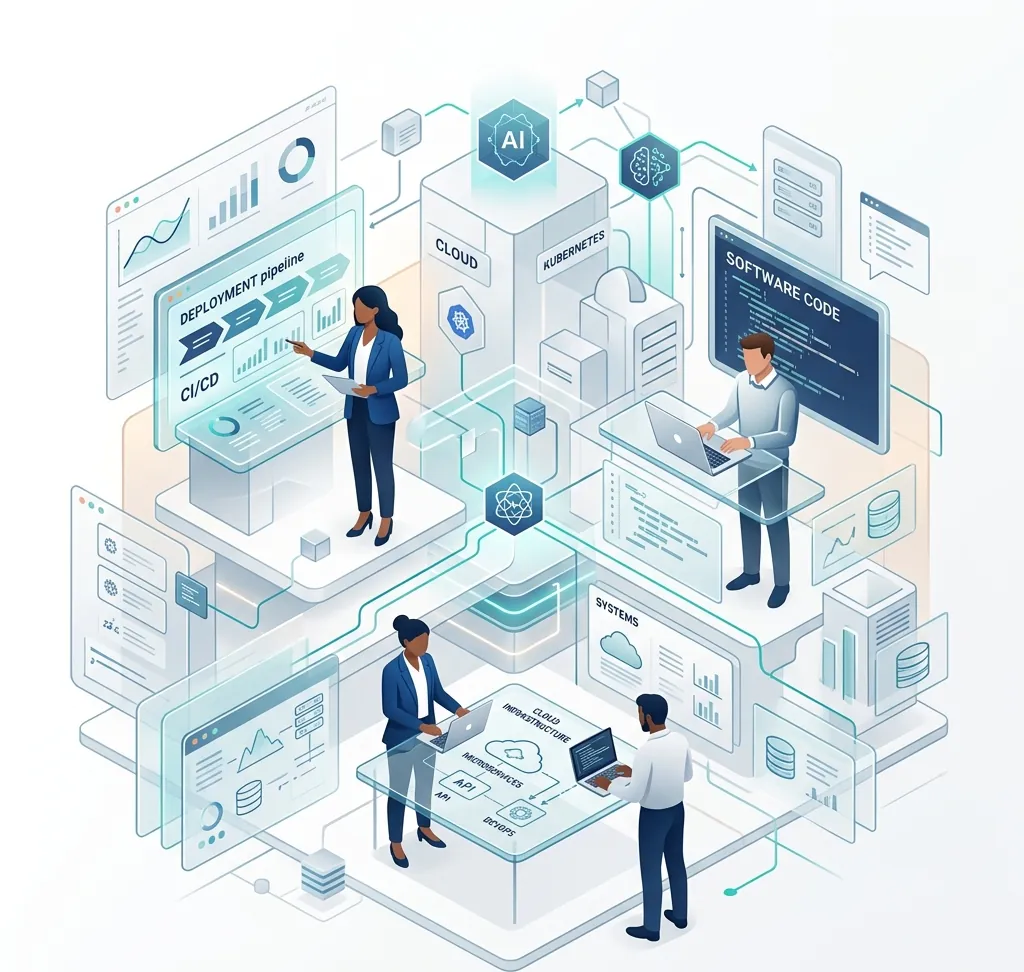
The Context Shaping Technology & Software
Understanding the macro trends and digital priorities driving the need for AI transformation in your sector.
Industry Trends
- Embedding generative AI into core SaaS products
- Shift towards autonomous IT operations (AIOps)
- Hyper-automation of software testing and QA
- Rise of AI-driven cybersecurity threats and defenses
Digital Priorities
- Modernizing legacy architectures to support AI workloads
- Implementing robust AI governance frameworks
- Enhancing developer productivity with AI coding assistants
- Optimizing cloud spend (FinOps) using machine learning
AI Maturity
The technology sector is at the forefront of AI maturity. Companies are not only adopting AI internally for operational efficiency but are also rapidly embedding foundational models and proprietary AI capabilities into their commercial product offerings.
The Challenges Shaping the Future of Technology & Software
Strategic barriers preventing organizations from scaling effectively, which AI is uniquely positioned to solve.
Talent Scarcity
Fierce competition for specialized AI, ML, and data engineering talent.
Rapid Pace of Innovation
The need to constantly innovate to avoid obsolescence as new AI capabilities emerge.
Data Privacy & Security
Managing complex data regulations globally while training AI on large datasets.
Cloud Cost Management
Skyrocketing computing costs associated with training and running large AI models.
Where AI Creates the Greatest Business Impact
How enterprise AI capabilities directly address your core challenges to unlock new value and operational efficiency.
AI-Augmented Development
Using AI coding assistants to significantly increase developer velocity.
Product Differentiation
Embedding generative AI features to create premium product tiers and drive upsells.
Automated Customer Success
Predicting churn and automating customer onboarding through personalized AI pathways.
AIOps
Automating IT infrastructure management, incident response, and performance tuning.
High-Value AI Use Cases Across the Technology & Software Value Chain
Proven applications driving measurable business value, efficiency, and transformation in Technology & Software.
1AI-Assisted Software Development
Software engineering is bottlenecked by manual coding, debugging, and boilerplate generation.
20-40% increase in developer productivity and faster feature delivery.
Integrating LLM-powered coding assistants into IDEs to suggest code, write tests, and document functions.
2Automated Quality Assurance (QA)
Manual testing is slow, error-prone, and struggles to keep up with agile release cycles.
Significant reduction in QA cycles and fewer bugs reaching production.
AI tools automatically generate and execute test scripts based on code changes and user flows.
3AIOps for Incident Management
IT teams are overwhelmed by alert fatigue and struggle to identify the root cause of outages quickly.
Faster Mean Time to Resolution (MTTR) and reduced system downtime.
Machine learning correlates millions of log events to pinpoint the root cause of an incident and suggest remediation steps.
4Predictive Customer Churn
SaaS companies often react too late when a customer decides to cancel their subscription.
Proactive retention strategies leading to a 10-15% reduction in churn.
Predictive models analyze product usage patterns, support ticket sentiment, and login frequency to flag at-risk accounts.
5Intelligent Threat Detection
Traditional rule-based security systems cannot detect novel, sophisticated cyberattacks.
Enhanced security posture and reduced risk of data breaches.
AI-driven anomaly detection models analyze network traffic behavior to identify zero-day exploits and insider threats.
6Generative AI in Product Features
Users expect smarter, more intuitive software interfaces that automate manual tasks.
Increased user engagement, product stickiness, and competitive advantage.
Embedding an AI copilot within a SaaS platform that allows users to generate reports, summaries, or designs via natural language.
7Automated Technical Support (Tier 1)
High volume of repetitive technical queries consumes expensive engineering support resources.
Deflection of up to 60% of basic support tickets.
An advanced conversational AI trained on the company's internal documentation and past tickets resolves user issues autonomously.
8Cloud FinOps Optimization
Wasted cloud resources and inefficient provisioning lead to spiraling infrastructure costs.
15-25% reduction in cloud spend without impacting performance.
AI continuously analyzes cloud utilization patterns to recommend rightsizing instances and purchasing reserved capacity.
9Sales Forecasting & Pipeline Management
Sales forecasts based on rep intuition are notoriously inaccurate, hindering business planning.
Highly accurate revenue forecasting and better resource allocation.
Machine learning models evaluate historical win rates, email engagement, and deal velocity to predict pipeline outcomes.
10Hyper-Personalized B2B Marketing
Generic outreach fails to capture the attention of technical B2B buyers.
Higher conversion rates on marketing campaigns and increased MQL generation.
AI personalizes landing pages and email outreach dynamically based on the visitor's company size, tech stack, and intent data.
11Automated Code Review & Security Scanning
Manual code reviews miss subtle vulnerabilities, and standard SAST tools generate too many false positives.
More secure codebase and reduced time spent on manual code reviews.
AI models trained on millions of secure code repositories review pull requests for security flaws and suggest secure alternatives.
12Product Telemetry Analytics
Product teams struggle to extract actionable insights from massive volumes of user behavior data.
Data-driven product roadmaps and better understanding of feature adoption.
AI clusters user behavior paths to identify UX friction points and predict which features drive long-term retention.
Building Responsible and Trusted AI
Technology companies face intense scrutiny regarding AI governance. They must ensure that the AI models they build and deploy are unbiased, secure, and transparent. Proper IP management and data handling practices are paramount, especially when training models on user data or open-source code. Synottic's Responsible AI frameworks ensure that your deployments meet critical standards for security, privacy, and fairness.
How Synottic Helps
- 1
AI Readiness Audit
We assess your data infrastructure and governance posture against Technology & Software regulatory standards.
- 2
Guardrails Implementation
Deploy enterprise guardrails to prevent data leakage, bias, and hallucination.
- 3
Continuous Monitoring
Automated drift detection and bias auditing for production models to ensure ongoing compliance.
Your Recommended AI Capability Journey
A structured capability-building roadmap tailored for Technology & Software professionals, from foundational literacy to enterprise-scale AI implementation.
Build Foundations
Understand AI terminology, concepts, and responsible use cases specific to Technology.
AI Literacy Essentials
Skills Acquired
- Master core principles and practical workflows of AI Literacy Essentials
- Apply AI capabilities to daily business deliverables and decisions
- Evaluate AI outputs critically for accuracy, safety, and governance
Generative AI Essentials
Skills Acquired
- Master core principles and practical workflows of Generative AI Essentials
- Apply AI capabilities to daily business deliverables and decisions
- Evaluate AI outputs critically for accuracy, safety, and governance
Develop Practical Skills
Master generative AI tools to improve daily productivity and communication in Technology.
Apply AI
Apply AI to function-specific workflows, operations, and strategic planning within Technology.
AI for Operations & Supply Chain
Skills Acquired
- Master core principles and practical workflows of AI for Operations & Supply Chain
- Apply AI capabilities to daily business deliverables and decisions
- Evaluate AI outputs critically for accuracy, safety, and governance
AI for Marketing
Skills Acquired
- Master core principles and practical workflows of AI for Marketing
- Apply AI capabilities to daily business deliverables and decisions
- Evaluate AI outputs critically for accuracy, safety, and governance
AI for Customer Service
Skills Acquired
- Master core principles and practical workflows of AI for Customer Service
- Apply AI capabilities to daily business deliverables and decisions
- Evaluate AI outputs critically for accuracy, safety, and governance
Govern & Scale
Deploy and govern secure, agentic AI systems that comply with Technology regulations.
Responsible AI Essentials
Skills Acquired
- Master core principles and practical workflows of Responsible AI Essentials
- Apply AI capabilities to daily business deliverables and decisions
- Evaluate AI outputs critically for accuracy, safety, and governance
AI Agents Essentials
Skills Acquired
- Master core principles and practical workflows of AI Agents Essentials
- Apply AI capabilities to daily business deliverables and decisions
- Evaluate AI outputs critically for accuracy, safety, and governance
Enterprise Capability
Scale AI adoption and build internal capability across your entire Technology organization.
The Synottic Transformation Journey
A structured pathway from discovery through to continuous business value, ensuring lasting impact.
How Synottic Helps You Succeed
End-to-end consulting and implementation services designed specifically for Technology & Software.
AI Readiness Assessment
Measure organisational AI maturity and identify strategic capability gaps.
AI Strategy
Align AI initiatives with business goals and operational priorities to maximize ROI.
Executive Advisory
Support senior leaders with AI strategy and long-term transformation planning.
Capability Building
Train your workforce with tailored, role-based AI enablement programs.
Responsible AI & Governance
Establish policies, controls, and ethical frameworks to mitigate AI risks.
Agentic AI & Implementation
Design and deploy autonomous AI agents for complex enterprise processes.