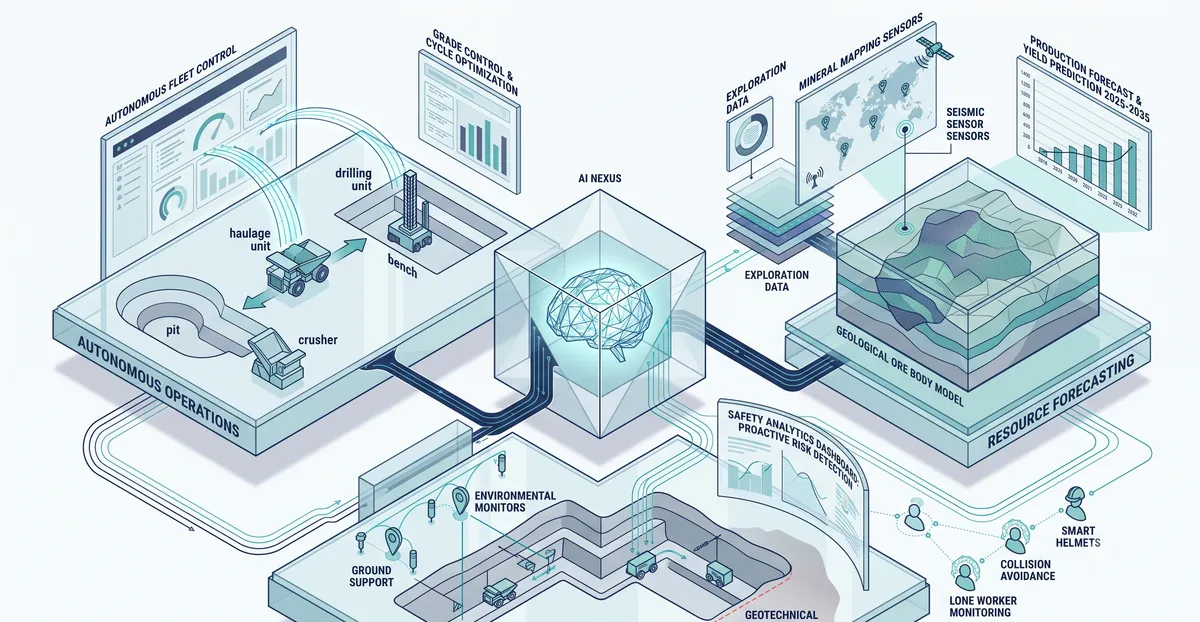
The Context Shaping Mining & Metals
Understanding the macro trends and digital priorities driving the need for AI transformation in your sector.
Industry Trends
- Transition toward fully autonomous 'smart mines'.
- Increased focus on decarbonization and ESG reporting powered by data analytics.
- Integration of IT (Information Technology) and OT (Operational Technology) networks.
- Deployment of private 5G/LTE networks in remote mining locations to support high-bandwidth AI applications.
Digital Priorities
- Establish robust edge computing capabilities in deep underground or remote open-pit environments.
- Unify disparate operational data silos into centralized data lakes.
- Implement advanced cybersecurity for critical OT infrastructure.
- Develop digital twins of entire mine-to-port value chains.
AI Maturity
The Mining & Metals sector is highly bifurcated. Tier-1 global miners are highly mature, operating fully autonomous fleets and advanced digital twins. However, mid-tier and junior miners are just beginning their AI journeys, focusing primarily on targeted predictive maintenance and basic operational reporting.
The Challenges Shaping the Future of Mining & Metals
Strategic barriers preventing organizations from scaling effectively, which AI is uniquely positioned to solve.
Declining Ore Grades
Extracting value requires processing more material, increasing energy consumption and costs.
Harsh Environments
Extreme conditions that cause rapid equipment degradation and pose severe safety risks to personnel.
ESG Pressures
Intense regulatory and social pressure to reduce carbon emissions, water usage, and environmental impact.
Supply Chain Volatility
Fluctuating commodity prices and geopolitical risks impacting long-term capital planning.
Where AI Creates the Greatest Business Impact
How enterprise AI capabilities directly address your core challenges to unlock new value and operational efficiency.
Enhanced Recovery Rates
Using AI to fine-tune processing parameters, extracting more valuable metal from lower-grade ore.
Zero-Harm Operations
Removing humans from hazardous environments via remote operation and autonomous robotics.
Energy Optimization
AI-driven scheduling of energy-intensive processes to align with renewable energy availability and off-peak pricing.
Rapid Resource Definition
Shortening the time from initial exploration to mine design using generative geological modeling.
High-Value AI Use Cases Across the Mining & Metals Value Chain
Proven applications driving measurable business value, efficiency, and transformation in Mining & Metals.
1AI-Targeted Mineral Exploration
Traditional exploration is slow, expensive, and relies heavily on sparse drill hole data, leading to low success rates.
Increased probability of finding viable ore bodies by 30% while reducing exploratory drilling costs.
Machine learning models analyze historical drill data, aeromagnetic surveys, and geochemical samples to predict the location and grade of hidden mineral deposits with high accuracy.
2Autonomous Haulage Systems (AHS)
Manual haul truck operations are prone to accidents, inconsistent cycle times, and require shift changes that disrupt continuous operations.
Increased fleet utilization by 20% and near-elimination of fatigue-related accidents.
Deploying fully autonomous, AI-driven haul trucks that navigate open-pit mines, optimizing routes in real-time to avoid congestion and minimize fuel consumption.
3Predictive Maintenance for Grinding Mills
Unexpected failures in critical processing equipment like SAG mills halt entire production lines, costing millions in lost revenue per day.
Reduced unplanned downtime by 40% and optimized maintenance scheduling.
Acoustic sensors and vibration monitors feed data into a deep learning model that predicts bearing or liner failures weeks in advance, allowing for planned maintenance.
4Froth Flotation Optimization
Varying ore characteristics make it difficult for human operators to constantly adjust chemical reagents to maximize metal recovery.
Increased recovery rates of copper/gold by 1-3%, translating to tens of millions in additional annual revenue.
Computer vision cameras monitor the color, bubble size, and velocity of the flotation froth, while an AI controller autonomously adjusts reagent dosing in real-time for optimal extraction.
5Digital Twin for Mine-to-Port Logistics
Siloed operations between the mine, processing plant, rail network, and port lead to bottlenecks and suboptimal blending of final products.
Throughput increased by 10% through holistic system optimization rather than isolated local optimizations.
A comprehensive digital twin simulates the entire supply chain. Reinforcement learning algorithms dynamically adjust rail schedules and stockpile blending based on real-time port capacity and market demands.
6Ventilation on Demand (VoD)
Underground mine ventilation systems typically run at full capacity 24/7, consuming massive amounts of electricity.
Reduced ventilation energy costs by up to 40% and improved underground air quality.
AI integrates with RFID personnel tracking and vehicle telemetry to dynamically route clean air only to active headings where people and diesel equipment are present.
7Drill and Blast Optimization
Suboptimal blasting results in large boulders that slow down excavation and crushing, or excessive fines that waste explosive energy.
Improved fragmentation leading to a 15% increase in crusher throughput and reduced explosive costs.
AI analyzes 3D geological models and drone surveys of previous blasts to design precise blast hole patterns and explosive charges tailored to specific rock hardness.
8Tailings Dam Monitoring
Catastrophic failure of tailings storage facilities poses severe environmental and human risks, requiring constant vigilance.
Early warning system prevents catastrophic failures and ensures compliance with global safety standards.
InSAR satellite imagery, ground-based radar, and piezometer data are fused in an AI model to detect millimeter-level ground deformation or abnormal seepage, triggering automated alerts.
9Automated Core Logging
Geologists spend excessive time manually inspecting and logging drill cores, a subjective process prone to inconsistencies.
Core logging speed increased by 400% with highly standardized, objective geological classification.
Automated core scanners use hyperspectral imaging and computer vision to instantly identify mineralogy, rock types, and structural fractures, feeding data directly into 3D block models.
10Scrap Metal Sorting for Recycling
In metal recycling, mixing incompatible alloys degrades the quality of the final product, but manual sorting is slow and inaccurate.
Increased purity of recycled aluminum/steel streams by 25%, maximizing scrap resale value.
Robotic arms equipped with X-ray fluorescence (XRF) and computer vision rapidly identify and separate specific metal alloys from mixed scrap streams on high-speed conveyors.
11Energy Price Arbitrage in Smelting
Smelting operations (e.g., aluminum) are highly energy-intensive, and volatile grid electricity prices severely impact profitability.
Reduced overall energy costs by 15% without impacting production targets.
Predictive AI models forecast short-term electricity market prices and dynamically modulate power consumption in the potlines during peak pricing spikes, taking advantage of cheaper off-peak rates.
12Geotechnical Fall-of-Ground Prediction
Rockfalls are a leading cause of fatalities in underground mining, often occurring without obvious visible warning signs.
Significantly enhanced worker safety by predicting micro-seismic events before major collapses occur.
Machine learning algorithms analyze continuous micro-seismic monitoring data to identify patterns indicative of increasing rock stress, automatically evacuating zones hours before a predicted rockburst.
13Supply Chain Carbon Tracking (Scope 3)
Metals producers face immense pressure to prove the 'green' credentials of their products to end-users like EV manufacturers.
Enabled premium pricing for 'green metals' through verifiable, immutable carbon footprints.
An AI-powered blockchain platform tracks the exact carbon emissions associated with every batch of metal, from extraction and processing to transportation, generating automated ESG compliance certificates.
Building Responsible and Trusted AI
Governance in Mining & Metals AI is heavily focused on operational safety, environmental compliance, and the security of critical infrastructure. Given the physical risks associated with autonomous heavy machinery and processing plants, AI models must adhere to strict deterministic safety boundaries. Cybersecurity is paramount, as attacks on OT networks could result in environmental disasters or loss of life. Synottic's Responsible AI frameworks ensure that your deployments meet critical standards for security, privacy, and fairness.
How Synottic Helps
- 1
AI Readiness Audit
We assess your data infrastructure and governance posture against Mining & Metals regulatory standards.
- 2
Guardrails Implementation
Deploy enterprise guardrails to prevent data leakage, bias, and hallucination.
- 3
Continuous Monitoring
Automated drift detection and bias auditing for production models to ensure ongoing compliance.
Your Recommended AI Capability Journey
A structured capability-building roadmap tailored for Mining & Metals professionals, from foundational literacy to enterprise-scale AI implementation.
Build Foundations
Understand AI terminology, concepts, and responsible use cases specific to Mining Metals.
Develop Practical Skills
Master generative AI tools to improve daily productivity and communication in Mining Metals.
Apply AI
Apply AI to function-specific workflows, operations, and strategic planning within Mining Metals.
AI for Operations & Supply Chain
Skills Acquired
- Master core principles and practical workflows of AI for Operations & Supply Chain
- Apply AI capabilities to daily business deliverables and decisions
- Evaluate AI outputs critically for accuracy, safety, and governance
AI for Procurement
Skills Acquired
- Master core principles and practical workflows of AI for Procurement
- Apply AI capabilities to daily business deliverables and decisions
- Evaluate AI outputs critically for accuracy, safety, and governance
Govern & Scale
Deploy and govern secure, agentic AI systems that comply with Mining Metals regulations.
Enterprise Capability
Scale AI adoption and build internal capability across your entire Mining Metals organization.
The Synottic Transformation Journey
A structured pathway from discovery through to continuous business value, ensuring lasting impact.
How Synottic Helps You Succeed
End-to-end consulting and implementation services designed specifically for Mining & Metals.
AI Readiness Assessment
Measure organisational AI maturity and identify strategic capability gaps.
AI Strategy
Align AI initiatives with business goals and operational priorities to maximize ROI.
Executive Advisory
Support senior leaders with AI strategy and long-term transformation planning.
Capability Building
Train your workforce with tailored, role-based AI enablement programs.
Responsible AI & Governance
Establish policies, controls, and ethical frameworks to mitigate AI risks.
Agentic AI & Implementation
Design and deploy autonomous AI agents for complex enterprise processes.