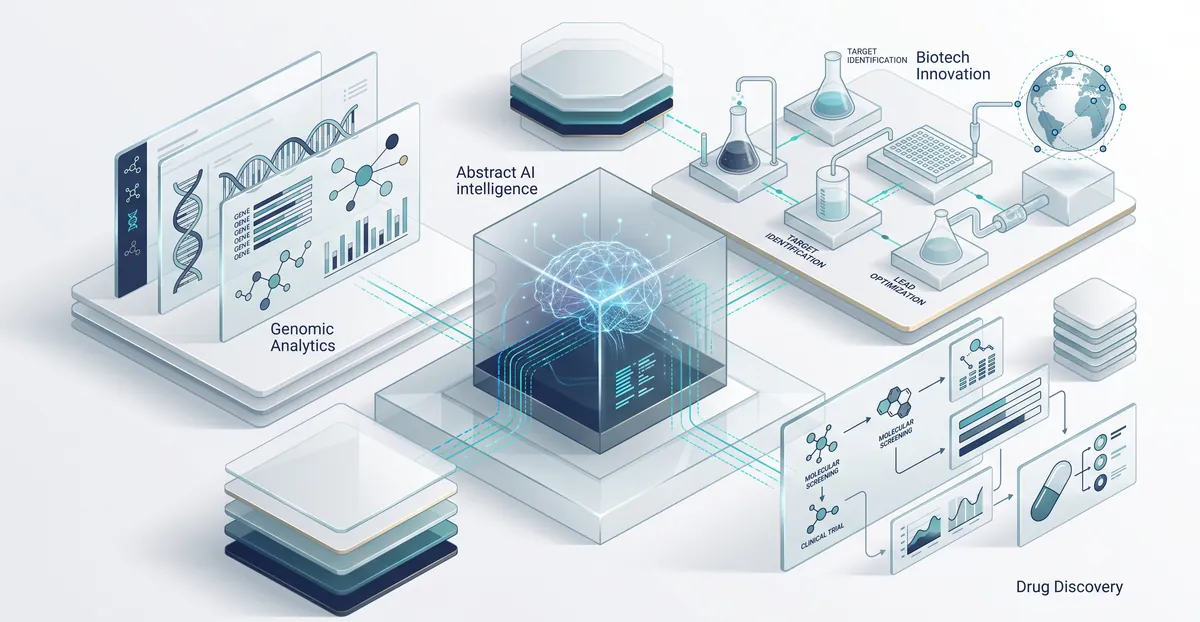
The Context Shaping Life Sciences
Understanding the macro trends and digital priorities driving the need for AI transformation in your sector.
Industry Trends
- Convergence of biology and data science
- Rise of connected, intelligent medical devices (IoMT)
- Advances in synthetic biology and gene editing
- Transition to continuous bioprocessing
Digital Priorities
- Build scalable bioinformatics pipelines
- Integrate AI into Software as a Medical Device (SaMD)
- Enhance laboratory automation and robotics
- Unify disparate research data lakes
AI Maturity
Life sciences is deeply rooted in data. AI is heavily utilized in bioinformatics and genomic sequencing. The current frontier involves integrating GenAI for rapid literature synthesis and embedding edge AI into next-generation medical devices.
The Challenges Shaping the Future of Life Sciences
Strategic barriers preventing organizations from scaling effectively, which AI is uniquely positioned to solve.
Data Volume & Complexity
Genomic and transcriptomic data sets are massive and difficult to process efficiently.
Reproducibility Crisis
Inconsistent lab conditions make it hard to reproduce experimental results.
Strict Device Regulations
Regulatory bodies mandate rigid validation for AI algorithms in medical devices.
Talent Scarcity
A severe shortage of professionals who understand both biology and advanced AI.
Where AI Creates the Greatest Business Impact
How enterprise AI capabilities directly address your core challenges to unlock new value and operational efficiency.
Accelerated Genomics
Rapid identification of disease-causing mutations.
Smart MedTech
Devices that learn and adapt to patient needs in real-time.
Automated Literature Review
Synthesizing thousands of research papers instantly.
Precision Agriculture/Biotech
Optimizing crop yields and synthetic biology processes.
High-Value AI Use Cases Across the Life Sciences Value Chain
Proven applications driving measurable business value, efficiency, and transformation in Life Sciences.
1Next-Generation Sequencing (NGS) Analysis
Processing terabytes of raw genomic data is computationally expensive and slow.
Drastic reduction in genome alignment and variant calling times.
AI-accelerated bioinformatics pipelines identify single nucleotide polymorphisms (SNPs) associated with rare diseases in hours instead of days.
2Biomedical Literature Mining
Researchers cannot keep up with the exponential growth of published scientific papers.
Faster hypothesis generation and comprehensive literature reviews.
GenAI applications read and summarize thousands of PubMed articles, extracting protein-protein interactions and novel findings.
3Medical Device Predictive Maintenance
Unexpected downtime of million-dollar lab equipment or MRI machines disrupts research and care.
25% increase in equipment uptime and reduced maintenance costs.
IoT sensors and machine learning predict component failures in sequencing machines before they occur.
4Algorithm Updates for SaMD
Continuous learning AI models in medical devices conflict with traditional static FDA approvals.
Safe, compliant rollout of improved diagnostic algorithms.
Implementing Predetermined Change Control Plans (PCCPs) to allow AI in imaging devices to update safely based on new data.
5Spatial Transcriptomics Analysis
Mapping gene expression across tissue structures generates complex visual and genetic data.
Deeper understanding of tumor microenvironments.
Computer vision and deep learning map cellular interactions and gene expressions in 3D tissue samples.
6Laboratory Automation (Robotics)
Manual pipetting and sample preparation are error-prone and bottleneck high-throughput screening.
10x increase in assay throughput and reduced human error.
AI-driven robotic arms optimize liquid handling and sample routing dynamically based on real-time assay results.
7Synthetic Biology Design
Designing genetic circuits that behave predictably in living organisms is highly complex.
Faster development of engineered microbes for biomanufacturing.
Machine learning predicts how specific gene edits will impact the metabolic output of yeast or E. coli.
8Digital Twins for Bioreactors
Scaling up cell cultures from lab to production often results in unexpected yield drops.
Seamless scale-up and optimized bioprocess parameters.
A digital twin simulates fluid dynamics, temperature, and nutrient consumption to optimize physical bioreactor conditions.
9Clinical Decision Support in MedTech
Pacemakers or insulin pumps generate massive data but often rely on static thresholds.
More personalized, adaptive therapy delivery.
Edge AI algorithms embedded in wearable devices predict glycemic events or arrhythmias and adjust device behavior in real-time.
10Electronic Lab Notebook (ELN) Automation
Scientists spend significant time documenting experiments, leading to incomplete records.
Improved compliance and fully searchable experiment histories.
Voice-to-text and AI summarization automatically capture protocols, variables, and observations directly into the ELN.
11Toxicity Prediction
Late-stage failure of compounds due to unexpected toxicity is costly.
Early elimination of toxic compounds, saving millions in R&D.
Deep learning models predict hepatotoxicity and cardiotoxicity based on molecular structure and in-vitro assay data.
12Microbiome Analysis
Understanding the complex interactions within the human microbiome is computationally difficult.
Discovery of novel probiotics and microbiome-targeted therapies.
AI clusters and analyzes massive metagenomic datasets to correlate specific microbial populations with health states.
Building Responsible and Trusted AI
Life sciences governance heavily overlaps with healthcare and pharma, emphasizing data provenance, algorithmic transparency for SaMD, and strict ethical standards regarding genomic data privacy. Synottic's Responsible AI frameworks ensure that your deployments meet critical standards for security, privacy, and fairness.
How Synottic Helps
- 1
AI Readiness Audit
We assess your data infrastructure and governance posture against Life Sciences regulatory standards.
- 2
Guardrails Implementation
Deploy enterprise guardrails to prevent data leakage, bias, and hallucination.
- 3
Continuous Monitoring
Automated drift detection and bias auditing for production models to ensure ongoing compliance.
Your Recommended AI Capability Journey
A structured capability-building roadmap tailored for Life Sciences professionals, from foundational literacy to enterprise-scale AI implementation.
Build Foundations
Understand AI terminology, concepts, and responsible use cases specific to Life Sciences.
AI Literacy Essentials
Skills Acquired
- Master core principles and practical workflows of AI Literacy Essentials
- Apply AI capabilities to daily business deliverables and decisions
- Evaluate AI outputs critically for accuracy, safety, and governance
Generative AI Essentials
Skills Acquired
- Master core principles and practical workflows of Generative AI Essentials
- Apply AI capabilities to daily business deliverables and decisions
- Evaluate AI outputs critically for accuracy, safety, and governance
Develop Practical Skills
Master generative AI tools to improve daily productivity and communication in Life Sciences.
Apply AI
Apply AI to function-specific workflows, operations, and strategic planning within Life Sciences.
AI for Operations & Supply Chain
Skills Acquired
- Master core principles and practical workflows of AI for Operations & Supply Chain
- Apply AI capabilities to daily business deliverables and decisions
- Evaluate AI outputs critically for accuracy, safety, and governance
AI for Marketing
Skills Acquired
- Master core principles and practical workflows of AI for Marketing
- Apply AI capabilities to daily business deliverables and decisions
- Evaluate AI outputs critically for accuracy, safety, and governance
AI for Customer Service
Skills Acquired
- Master core principles and practical workflows of AI for Customer Service
- Apply AI capabilities to daily business deliverables and decisions
- Evaluate AI outputs critically for accuracy, safety, and governance
Govern & Scale
Deploy and govern secure, agentic AI systems that comply with Life Sciences regulations.
Enterprise Capability
Scale AI adoption and build internal capability across your entire Life Sciences organization.
The Synottic Transformation Journey
A structured pathway from discovery through to continuous business value, ensuring lasting impact.
How Synottic Helps You Succeed
End-to-end consulting and implementation services designed specifically for Life Sciences.
AI Readiness Assessment
Measure organisational AI maturity and identify strategic capability gaps.
AI Strategy
Align AI initiatives with business goals and operational priorities to maximize ROI.
Executive Advisory
Support senior leaders with AI strategy and long-term transformation planning.
Capability Building
Train your workforce with tailored, role-based AI enablement programs.
Responsible AI & Governance
Establish policies, controls, and ethical frameworks to mitigate AI risks.
Agentic AI & Implementation
Design and deploy autonomous AI agents for complex enterprise processes.