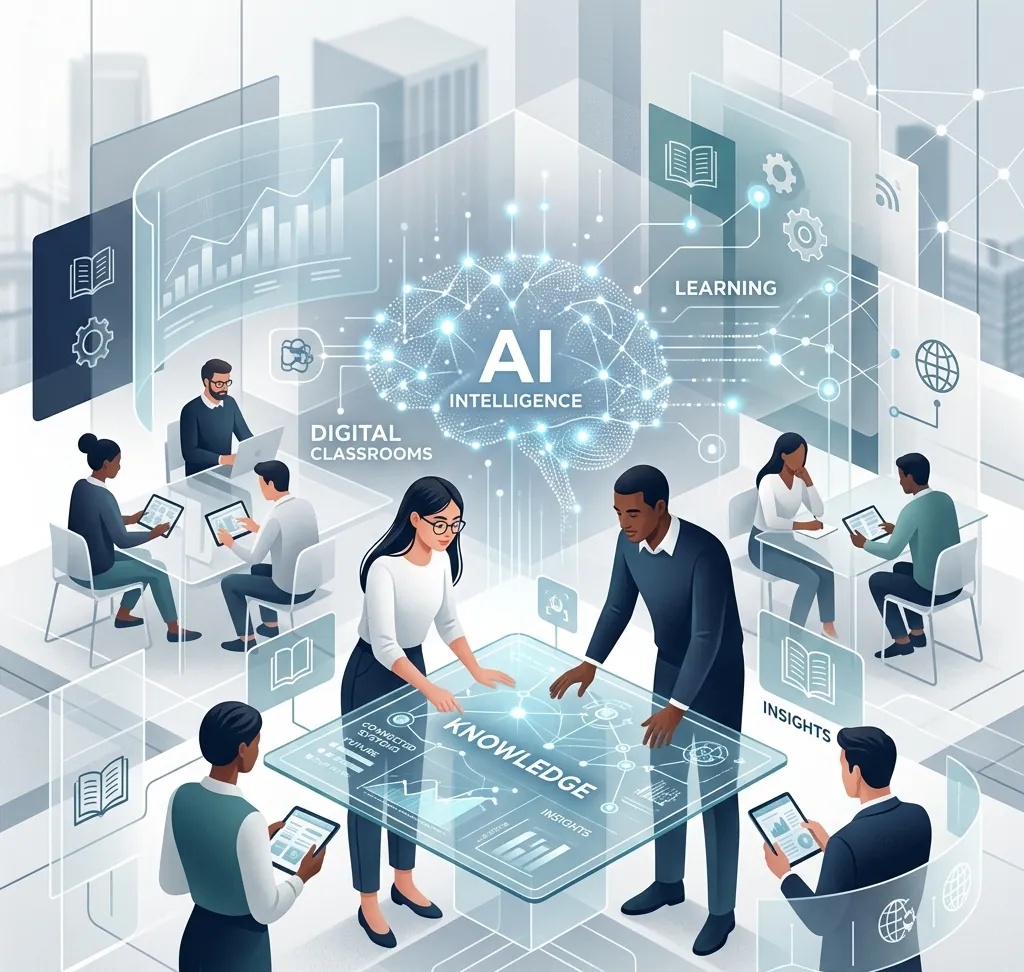
The Context Shaping Education & EdTech
Understanding the macro trends and digital priorities driving the need for AI transformation in your sector.
Industry Trends
- Rise of hyper-personalized adaptive learning platforms
- Use of generative AI for automated grading and tutoring
- Predictive analytics for student intervention
- Shift towards lifelong learning and micro-credentials
Digital Priorities
- Integrating AI tutors into Learning Management Systems (LMS)
- Modernizing student information systems (SIS)
- Enhancing campus safety through AI-driven surveillance
- Ensuring AI accessibility for all student demographics
AI Maturity
The education sector's AI maturity is rapidly accelerating. While traditional K-12 institutions lag due to budget constraints, Higher Ed and EdTech startups are aggressively adopting generative AI and predictive analytics to reshape learning.
The Challenges Shaping the Future of Education & EdTech
Strategic barriers preventing organizations from scaling effectively, which AI is uniquely positioned to solve.
Student Engagement and Retention
High dropout rates and declining engagement, especially in online and hybrid learning models.
Teacher Burnout
Educators are overwhelmed by administrative tasks, grading, and large class sizes.
Educational Inequity
The digital divide prevents all students from accessing advanced AI-powered learning tools equally.
Data Privacy and Cheating
Balancing the use of student data for personalization while combating AI-assisted plagiarism.
Where AI Creates the Greatest Business Impact
How enterprise AI capabilities directly address your core challenges to unlock new value and operational efficiency.
Adaptive Learning
Creating personalized learning paths that adapt in real-time to a student's proficiency level.
Intelligent Tutoring Systems
Providing 24/7 AI-powered tutoring that offers hints and explanations, not just answers.
Automated Administrative Tasks
Freeing up educator time by automating grading, scheduling, and enrollment processes.
Predictive Interventions
Identifying at-risk students early and triggering proactive counseling or academic support.
High-Value AI Use Cases Across the Education & EdTech Value Chain
Proven applications driving measurable business value, efficiency, and transformation in Education & EdTech.
1Adaptive Learning Pathways
A one-size-fits-all curriculum fails to challenge advanced students and leaves struggling students behind.
Improved test scores, deeper subject comprehension, and higher student engagement.
AI continuously analyzes a student's performance on assessments and dynamically adjusts the difficulty and topic of the next lesson.
2AI-Powered Grading & Feedback
Grading essays and open-ended questions takes up hours of an educator's time, leading to delayed feedback.
Immediate feedback for students and a 50% reduction in grading time for teachers.
NLP models automatically grade written assignments based on rubrics, providing instant, constructive feedback on grammar, structure, and content.
3Predictive Analytics for Student Retention
Universities struggle to identify which students are likely to drop out before it's too late to intervene.
Increased graduation rates and optimized use of counseling resources.
Machine learning models analyze attendance, LMS login frequency, grades, and financial aid status to flag at-risk students for early intervention.
424/7 Virtual AI Tutors
Students often get stuck on homework outside of school hours and cannot access immediate help.
Reduced frustration, better homework completion rates, and democratized access to tutoring.
Generative AI chatbots engage students in a Socratic dialogue, asking guiding questions to help them arrive at the answer themselves.
5Automated Curriculum Generation
Developing new course materials, quizzes, and lesson plans is a highly time-consuming manual process.
Faster course development and more diverse, up-to-date learning materials.
Educators use LLMs to instantly generate reading summaries, multiple-choice questions, and lesson outlines based on a core text.
6Smart Campus and Resource Management
Inefficient use of campus facilities, high energy costs, and complex class scheduling.
Optimized campus operations, lower energy bills, and conflict-free schedules.
AI algorithms optimize classroom assignments based on course enrollment, faculty availability, and building energy usage patterns.
7AI-Assisted Language Learning
Learning a new language requires conversational practice that is difficult to scale in a traditional classroom.
Faster language acquisition and improved conversational fluency.
Speech recognition and generative AI converse with students in real-time, correcting pronunciation and grammar.
8Accessibility and Inclusion Tools
Students with disabilities often struggle with standard course materials and lectures.
A more inclusive learning environment that complies with accessibility standards.
AI provides real-time closed captioning for lectures, translates text to speech for visually impaired students, and simplifies complex texts for students with cognitive disabilities.
9Enrollment and Admissions Forecasting
Universities rely on inaccurate historical models to predict enrollment numbers, impacting budgets.
Highly accurate enrollment predictions, leading to better financial planning.
Predictive models analyze demographic trends, economic indicators, and applicant interaction data to forecast yield rates.
10Plagiarism and AI-Content Detection
The rise of generative AI has made traditional plagiarism checkers obsolete, threatening academic integrity.
Maintained academic standards and fair assessment of student work.
Advanced AI models detect linguistic patterns and perplexity scores to identify text generated by other AI systems rather than a human student.
11Personalized Career Pathways
Students struggle to connect their coursework with future career opportunities.
Higher post-graduation employment rates and better alignment with industry needs.
AI matches a student's skills, interests, and academic performance with current job market data to recommend specific courses and internships.
12Alumni Engagement & Fundraising
Generic fundraising appeals to alumni result in low donation rates.
Increased endowment contributions through targeted outreach.
AI analyzes alumni data (career trajectory, past donations, event attendance) to predict the best time, amount, and message for fundraising requests.
Building Responsible and Trusted AI
AI governance in education centers heavily on student data privacy (FERPA in the US) and the ethical use of AI in assessments. Institutions must ensure AI grading systems are unbiased and that predictive models do not unfairly profile students based on demographic data. Synottic's Responsible AI frameworks ensure that your deployments meet critical standards for security, privacy, and fairness.
How Synottic Helps
- 1
AI Readiness Audit
We assess your data infrastructure and governance posture against Education & EdTech regulatory standards.
- 2
Guardrails Implementation
Deploy enterprise guardrails to prevent data leakage, bias, and hallucination.
- 3
Continuous Monitoring
Automated drift detection and bias auditing for production models to ensure ongoing compliance.
Your Recommended AI Capability Journey
A structured capability-building roadmap tailored for Education & EdTech professionals, from foundational literacy to enterprise-scale AI implementation.
Build Foundations
Understand AI terminology, concepts, and responsible use cases specific to Education.
AI Literacy Essentials
Skills Acquired
- Master core principles and practical workflows of AI Literacy Essentials
- Apply AI capabilities to daily business deliverables and decisions
- Evaluate AI outputs critically for accuracy, safety, and governance
Generative AI Essentials
Skills Acquired
- Master core principles and practical workflows of Generative AI Essentials
- Apply AI capabilities to daily business deliverables and decisions
- Evaluate AI outputs critically for accuracy, safety, and governance
Develop Practical Skills
Master generative AI tools to improve daily productivity and communication in Education.
Apply AI
Apply AI to function-specific workflows, operations, and strategic planning within Education.
AI for Operations & Supply Chain
Skills Acquired
- Master core principles and practical workflows of AI for Operations & Supply Chain
- Apply AI capabilities to daily business deliverables and decisions
- Evaluate AI outputs critically for accuracy, safety, and governance
AI for Marketing
Skills Acquired
- Master core principles and practical workflows of AI for Marketing
- Apply AI capabilities to daily business deliverables and decisions
- Evaluate AI outputs critically for accuracy, safety, and governance
AI for Customer Service
Skills Acquired
- Master core principles and practical workflows of AI for Customer Service
- Apply AI capabilities to daily business deliverables and decisions
- Evaluate AI outputs critically for accuracy, safety, and governance
Govern & Scale
Deploy and govern secure, agentic AI systems that comply with Education regulations.
Responsible AI Essentials
Skills Acquired
- Master core principles and practical workflows of Responsible AI Essentials
- Apply AI capabilities to daily business deliverables and decisions
- Evaluate AI outputs critically for accuracy, safety, and governance
AI Agents Essentials
Skills Acquired
- Master core principles and practical workflows of AI Agents Essentials
- Apply AI capabilities to daily business deliverables and decisions
- Evaluate AI outputs critically for accuracy, safety, and governance
Enterprise Capability
Scale AI adoption and build internal capability across your entire Education organization.
The Synottic Transformation Journey
A structured pathway from discovery through to continuous business value, ensuring lasting impact.
How Synottic Helps You Succeed
End-to-end consulting and implementation services designed specifically for Education & EdTech.
AI Readiness Assessment
Measure organisational AI maturity and identify strategic capability gaps.
AI Strategy
Align AI initiatives with business goals and operational priorities to maximize ROI.
Executive Advisory
Support senior leaders with AI strategy and long-term transformation planning.
Capability Building
Train your workforce with tailored, role-based AI enablement programs.
Responsible AI & Governance
Establish policies, controls, and ethical frameworks to mitigate AI risks.
Agentic AI & Implementation
Design and deploy autonomous AI agents for complex enterprise processes.