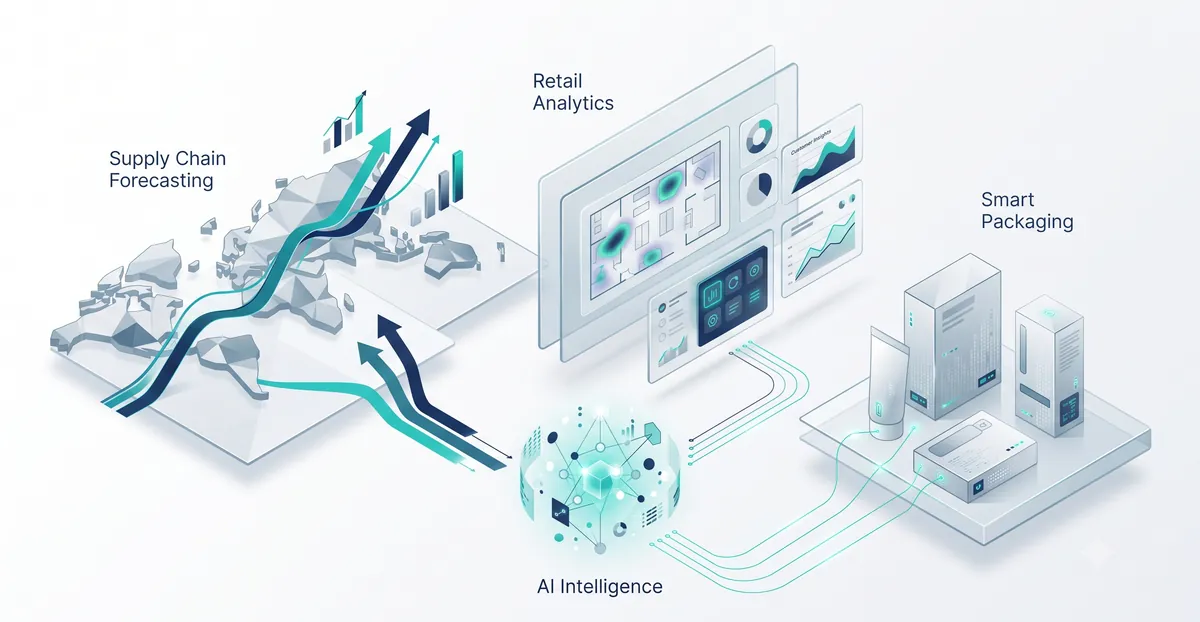
The Context Shaping Consumer Goods (CPG)
Understanding the macro trends and digital priorities driving the need for AI transformation in your sector.
Industry Trends
- Accelerated shift towards D2C models
- Sustainable and traceable sourcing
- Data-driven product development
- Automation in manufacturing
Digital Priorities
- End-to-end supply chain visibility
- Advanced analytics for pricing and promotions
- Consumer data acquisition and CDP implementation
- Smart manufacturing and IoT integration
AI Maturity
The CPG industry shows varying levels of AI maturity. Global leaders are heavily leveraging AI for demand forecasting and smart manufacturing, while mid-market players are focused on basic automation and analytics.
The Challenges Shaping the Future of Consumer Goods (CPG)
Strategic barriers preventing organizations from scaling effectively, which AI is uniquely positioned to solve.
Supply Chain Disruptions
Global instability and raw material shortages make forecasting and procurement extremely volatile.
Shifting Consumer Preferences
Rapidly changing consumer tastes demand faster product innovation cycles.
Retailer Consolidation
Increasing power of massive retail chains squeezes CPG margins.
Sustainability Pressures
Regulatory and consumer demands for eco-friendly packaging and reduced carbon footprint.
Where AI Creates the Greatest Business Impact
How enterprise AI capabilities directly address your core challenges to unlock new value and operational efficiency.
Precision Marketing
Targeting micro-segments with highly personalized content across digital channels.
Smart Manufacturing
Using IoT and AI to optimize production lines, reduce waste, and predict maintenance.
Trade Promotion Optimization
AI models to determine the optimal spend and timing for retail promotions.
Generative Product Design
Accelerating R&D by using AI to formulate new recipes, materials, or packaging designs.
High-Value AI Use Cases Across the Consumer Goods (CPG) Value Chain
Proven applications driving measurable business value, efficiency, and transformation in Consumer Goods (CPG).
1Demand Sensing & Forecasting
Traditional historical-based forecasting fails to capture rapid shifts in consumer demand.
Improved forecast accuracy by 15-20%, leading to optimized inventory and fewer stockouts.
AI models analyze downstream POS data, social sentiment, and macro-economic factors to predict short-term demand.
2Trade Promotion Optimization (TPO)
Significant marketing spend is wasted on ineffective trade promotions and discounts.
10-15% increase in promotion ROI and better retailer collaboration.
Machine learning algorithms simulate different promotion scenarios to identify the most profitable discount structures and timing.
3Predictive Maintenance in Manufacturing
Unexpected equipment failure leads to costly production downtime and wasted raw materials.
Up to 30% reduction in maintenance costs and a 20% increase in machine uptime.
IoT sensors stream vibration and temperature data to AI models that predict failures before they occur.
4AI-Driven Product Formulation
Developing new flavors, fragrances, or chemical formulations is a slow, iterative, manual process.
50% reduction in R&D time-to-market for new product variations.
Generative AI suggests novel ingredient combinations based on consumer preference data and chemical properties.
5Quality Control Automation
Manual visual inspection on fast-moving production lines is prone to human error.
Near 100% defect detection rate, reducing recalls and scrap.
High-speed computer vision systems inspect every product for packaging defects, fill levels, or labeling errors in real-time.
6Supply Chain Risk Management
Lack of visibility into tier-2 and tier-3 suppliers leaves companies vulnerable to hidden risks.
Proactive risk mitigation and more resilient sourcing strategies.
Natural Language Processing (NLP) continuously monitors global news and financial data to alert supply chain managers to supplier risks.
7Dynamic Route Planning for Distribution
Inefficient delivery routes to retailers increase fuel costs and carbon emissions.
10-15% reduction in logistics costs and improved on-time delivery rates.
AI optimization algorithms continuously calculate the most efficient delivery routes based on traffic, weather, and delivery windows.
8Consumer Sentiment Analysis
Relying on traditional focus groups is slow and doesn't capture real-time brand perception.
Faster response to PR issues and better alignment of marketing messaging.
NLP models analyze millions of social media posts, reviews, and forum discussions to gauge real-time brand sentiment.
9Personalized D2C Marketing
Generic email blasts yield low conversion rates in Direct-to-Consumer channels.
20-30% higher conversion rates and increased customer lifetime value.
AI segments D2C customers based on purchase history and browsing behavior to trigger hyper-personalized email and SMS campaigns.
10Shelf Space Optimization
Suboptimal product placement on retail shelves leads to lost sales opportunities.
Increased sales velocity and better compliance with retailer agreements.
Computer vision processes photos taken by field reps to instantly audit shelf share, out-of-stocks, and competitor placement.
11Sustainable Packaging Design
Designing packaging that uses less plastic while maintaining durability is complex.
Significant reduction in material costs and carbon footprint.
AI simulates stress tests on various eco-friendly material combinations to find the optimal packaging design.
12Procurement Price Forecasting
Volatile raw material prices (e.g., wheat, oil, plastic) make procurement budgeting difficult.
Better hedging strategies and 3-5% reduction in raw material costs.
Predictive models analyze commodities markets, weather patterns, and geopolitical events to forecast raw material prices.
Building Responsible and Trusted AI
CPG companies must strictly govern AI applications that interact with consumer data (D2C) and those that impact product safety (R&D and Manufacturing). Ensuring traceability in AI decisions is critical for compliance with food safety and consumer protection regulations. Synottic's Responsible AI frameworks ensure that your deployments meet critical standards for security, privacy, and fairness.
How Synottic Helps
- 1
AI Readiness Audit
We assess your data infrastructure and governance posture against Consumer Goods (CPG) regulatory standards.
- 2
Guardrails Implementation
Deploy enterprise guardrails to prevent data leakage, bias, and hallucination.
- 3
Continuous Monitoring
Automated drift detection and bias auditing for production models to ensure ongoing compliance.
Your Recommended AI Capability Journey
A structured capability-building roadmap tailored for Consumer Goods (CPG) professionals, from foundational literacy to enterprise-scale AI implementation.
Build Foundations
Understand AI terminology, concepts, and responsible use cases specific to Consumer Goods.
AI Literacy Essentials
Skills Acquired
- Master core principles and practical workflows of AI Literacy Essentials
- Apply AI capabilities to daily business deliverables and decisions
- Evaluate AI outputs critically for accuracy, safety, and governance
Generative AI Essentials
Skills Acquired
- Master core principles and practical workflows of Generative AI Essentials
- Apply AI capabilities to daily business deliverables and decisions
- Evaluate AI outputs critically for accuracy, safety, and governance
Develop Practical Skills
Master generative AI tools to improve daily productivity and communication in Consumer Goods.
Apply AI
Apply AI to function-specific workflows, operations, and strategic planning within Consumer Goods.
AI for Operations & Supply Chain
Skills Acquired
- Master core principles and practical workflows of AI for Operations & Supply Chain
- Apply AI capabilities to daily business deliverables and decisions
- Evaluate AI outputs critically for accuracy, safety, and governance
AI for Marketing
Skills Acquired
- Master core principles and practical workflows of AI for Marketing
- Apply AI capabilities to daily business deliverables and decisions
- Evaluate AI outputs critically for accuracy, safety, and governance
AI for Customer Service
Skills Acquired
- Master core principles and practical workflows of AI for Customer Service
- Apply AI capabilities to daily business deliverables and decisions
- Evaluate AI outputs critically for accuracy, safety, and governance
Govern & Scale
Deploy and govern secure, agentic AI systems that comply with Consumer Goods regulations.
Responsible AI Essentials
Skills Acquired
- Master core principles and practical workflows of Responsible AI Essentials
- Apply AI capabilities to daily business deliverables and decisions
- Evaluate AI outputs critically for accuracy, safety, and governance
AI Agents Essentials
Skills Acquired
- Master core principles and practical workflows of AI Agents Essentials
- Apply AI capabilities to daily business deliverables and decisions
- Evaluate AI outputs critically for accuracy, safety, and governance
Enterprise Capability
Scale AI adoption and build internal capability across your entire Consumer Goods organization.
The Synottic Transformation Journey
A structured pathway from discovery through to continuous business value, ensuring lasting impact.
How Synottic Helps You Succeed
End-to-end consulting and implementation services designed specifically for Consumer Goods (CPG).
AI Readiness Assessment
Measure organisational AI maturity and identify strategic capability gaps.
AI Strategy
Align AI initiatives with business goals and operational priorities to maximize ROI.
Executive Advisory
Support senior leaders with AI strategy and long-term transformation planning.
Capability Building
Train your workforce with tailored, role-based AI enablement programs.
Responsible AI & Governance
Establish policies, controls, and ethical frameworks to mitigate AI risks.
Agentic AI & Implementation
Design and deploy autonomous AI agents for complex enterprise processes.