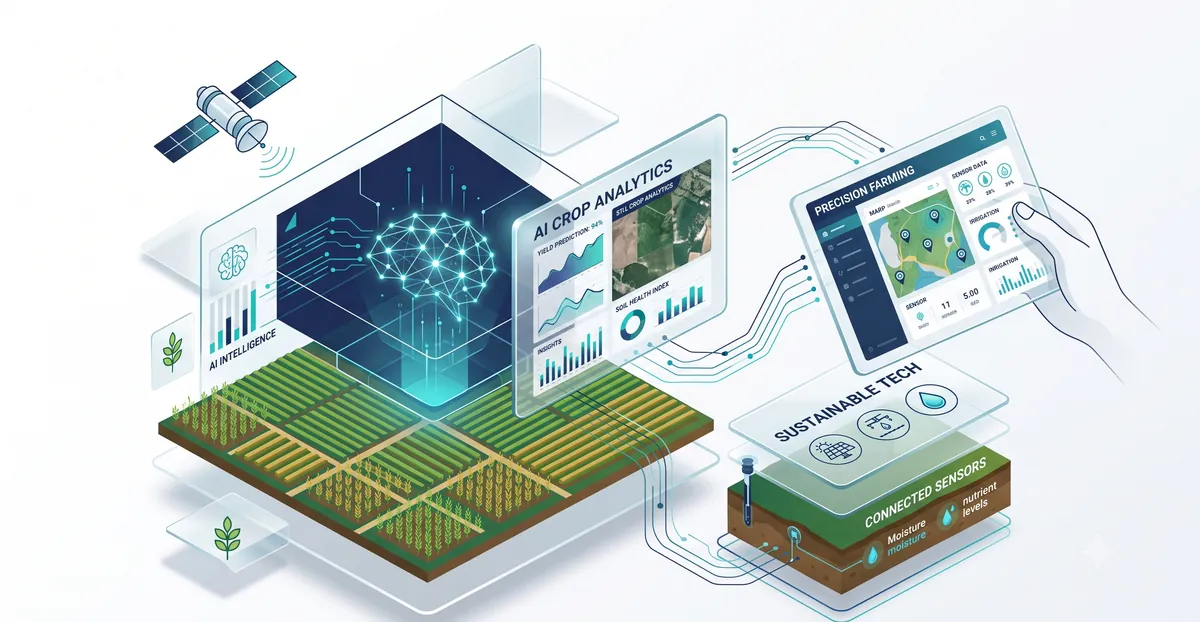
The Context Shaping Agriculture
Understanding the macro trends and digital priorities driving the need for AI transformation in your sector.
Industry Trends
- Widespread adoption of IoT sensors for micro-climate monitoring.
- Integration of satellite imagery and drone data for crop health analysis.
- Rise of vertical and indoor farming with AI-controlled environments.
- Shift towards regenerative agriculture backed by predictive modeling.
Digital Priorities
- Modernize data infrastructure to handle high-velocity agronomic data.
- Implement edge computing for real-time autonomous machinery decisions.
- Enhance farm management software with predictive analytics.
- Develop robust cybersecurity measures for connected farming equipment.
AI Maturity
The agriculture sector is experiencing rapid acceleration in AI adoption. While historically a laggard in digital transformation, the pressing need for sustainable intensification and resilience against climate change has driven significant investments in predictive analytics, computer vision, and autonomous systems.
The Challenges Shaping the Future of Agriculture
Strategic barriers preventing organizations from scaling effectively, which AI is uniquely positioned to solve.
Climate Volatility
Unpredictable weather patterns severely impacting crop yields and resource planning.
Resource Scarcity
Increasingly limited access to fresh water and arable land necessitating hyper-efficient usage.
Labor Shortages
Chronic lack of skilled and manual agricultural labor, especially during peak harvest seasons.
Supply Chain Disruptions
Vulnerabilities in global logistics affecting the timely distribution of perishable goods.
Where AI Creates the Greatest Business Impact
How enterprise AI capabilities directly address your core challenges to unlock new value and operational efficiency.
Yield Optimization
Leveraging ML models on soil and weather data to prescribe optimal planting and harvesting strategies.
Pest and Disease Management
Early detection of infestations using computer vision on drone-captured imagery.
Automated Harvesting
Robotics and AI collaborating to pick ripe produce without human intervention.
Smart Irrigation
AI-driven irrigation systems that water crops based on real-time soil moisture and weather forecasts.
High-Value AI Use Cases Across the Agriculture Value Chain
Proven applications driving measurable business value, efficiency, and transformation in Agriculture.
1Predictive Crop Yield Modeling
Farmers struggle to accurately forecast harvest volumes, leading to inefficient pricing and supply chain planning.
Increased forecast accuracy by 25%, enabling better forward contracting and reduced spoilage.
Deep learning models process historical yield data, current satellite imagery, and localized weather forecasts to predict end-of-season yields at the field level.
2Computer Vision for Weed Detection
Blanket application of herbicides is costly, environmentally damaging, and leads to resistant superweeds.
Reduced herbicide usage by up to 80%, lowering costs and environmental impact.
Tractor-mounted cameras use edge AI to distinguish between crops and weeds in real-time, triggering micro-sprayers to target only the weeds.
3Autonomous Tractors and Harvesters
Severe labor shortages and the need for 24/7 operations during critical narrow planting/harvesting windows.
Increased operational uptime by 40% and reduced dependency on scarce seasonal labor.
Self-driving tractors equipped with LiDAR, GPS, and computer vision navigate fields autonomously, performing tilling, planting, and harvesting.
4AI-Driven Smart Irrigation
Water scarcity and inefficient blanket irrigation methods lead to massive water waste and sub-optimal crop growth.
Reduced water consumption by 30% while maintaining or improving crop yields.
Reinforcement learning algorithms continuously adjust irrigation schedules based on soil moisture sensors, evapotranspiration rates, and hyper-local weather predictions.
5Early Disease Detection via Drones
Crop diseases can spread rapidly; manual scouting is too slow and often identifies problems only after significant damage has occurred.
Early intervention prevents up to 15% of crop loss from disease outbreaks.
Drones capture multispectral imagery which is analyzed by CNNs to detect early signs of fungal infections or nutrient deficiencies before they are visible to the human eye.
6Livestock Health Monitoring
Detecting illness in large herds manually is difficult, leading to disease spread and decreased production.
Reduced mortality rates by 10% and improved overall herd productivity.
Computer vision systems in barns monitor animal behavior, eating patterns, and mobility to flag early signs of illness or distress in individual animals.
7Supply Chain Demand Forecasting
Mismatch between harvested perishable goods and market demand leads to significant food waste and lost revenue.
Reduced food waste in the initial supply chain stages by 20%.
Time-series forecasting models analyze market trends, consumer behavior, and macroeconomic indicators to guide farmers on optimal harvest timing and distribution routes.
8Genetic Selection for Breeding
Traditional breeding programs are slow and rely heavily on phenotypic observation, taking years to develop resilient strains.
Accelerated development of drought-resistant and high-yield crop varieties by 3x.
Machine learning algorithms analyze genomic data and predict phenotypic traits, allowing breeders to select the optimal parent plants digitally before physical trials.
9Automated Sorting and Grading
Manual sorting of harvested produce is labor-intensive, slow, and subjective, leading to inconsistent quality.
Increased sorting throughput by 50% with near-perfect consistency in quality grading.
High-speed conveyor systems use computer vision and spectroscopy to assess the size, color, and internal brix (sugar) levels of fruit, sorting them automatically into different quality tiers.
10Predictive Maintenance for Farm Equipment
Equipment breakdowns during critical planting or harvesting windows result in devastating operational delays.
Decreased unexpected machinery downtime by 35% and extended equipment lifespan.
IoT sensors on combines and tractors stream vibration and temperature data to an AI model that predicts component failure weeks before it happens, scheduling preemptive maintenance.
11Soil Carbon Sequestration Modeling
Farmers struggle to accurately measure and verify soil carbon capture to participate in lucrative carbon credit markets.
Enabled access to new revenue streams via carbon credits by providing auditable, high-accuracy sequestration data.
AI models fuse soil sampling data, remote sensing, and farming practice logs to estimate and verify the amount of carbon sequestered in the soil over time.
12Agri-finance Credit Risk Assessment
Traditional banks often lack the specialized data to accurately assess the creditworthiness of small to medium agricultural enterprises.
Increased loan approval rates for sustainable farms by 25% with lower default rates.
Alternative credit scoring models use satellite imagery of a farm's historical crop health, predictive yield models, and local market prices to assess the true financial risk of agricultural loans.
13Optimized Fertilizer Formulation
Generic fertilizer applications fail to account for hyper-local soil variations, causing nutrient runoff and wasted expense.
Reduced fertilizer costs by 20% and significant reduction in environmentally harmful nitrogen runoff.
Generative AI suggests custom NPK (Nitrogen, Phosphorus, Potassium) blends for specific field zones based on historical yield maps and current soil sensor data.
Building Responsible and Trusted AI
Governance in agricultural AI centers on data ownership, environmental impact reporting, and the safety of autonomous heavy machinery. As farms become highly digitized, ensuring that farmers retain control over their agronomic data and that AI recommendations comply with environmental regulations is paramount. Synottic's Responsible AI frameworks ensure that your deployments meet critical standards for security, privacy, and fairness.
How Synottic Helps
- 1
AI Readiness Audit
We assess your data infrastructure and governance posture against Agriculture regulatory standards.
- 2
Guardrails Implementation
Deploy enterprise guardrails to prevent data leakage, bias, and hallucination.
- 3
Continuous Monitoring
Automated drift detection and bias auditing for production models to ensure ongoing compliance.
Your Recommended AI Capability Journey
A structured capability-building roadmap tailored for Agriculture professionals, from foundational literacy to enterprise-scale AI implementation.
Build Foundations
Understand AI terminology, concepts, and responsible use cases specific to Agriculture.
Develop Practical Skills
Master generative AI tools to improve daily productivity and communication in Agriculture.
Apply AI
Apply AI to function-specific workflows, operations, and strategic planning within Agriculture.
AI for Operations & Supply Chain
Skills Acquired
- Master core principles and practical workflows of AI for Operations & Supply Chain
- Apply AI capabilities to daily business deliverables and decisions
- Evaluate AI outputs critically for accuracy, safety, and governance
AI for Procurement
Skills Acquired
- Master core principles and practical workflows of AI for Procurement
- Apply AI capabilities to daily business deliverables and decisions
- Evaluate AI outputs critically for accuracy, safety, and governance
Govern & Scale
Deploy and govern secure, agentic AI systems that comply with Agriculture regulations.
Enterprise Capability
Scale AI adoption and build internal capability across your entire Agriculture organization.
The Synottic Transformation Journey
A structured pathway from discovery through to continuous business value, ensuring lasting impact.
How Synottic Helps You Succeed
End-to-end consulting and implementation services designed specifically for Agriculture.
AI Readiness Assessment
Measure organisational AI maturity and identify strategic capability gaps.
AI Strategy
Align AI initiatives with business goals and operational priorities to maximize ROI.
Executive Advisory
Support senior leaders with AI strategy and long-term transformation planning.
Capability Building
Train your workforce with tailored, role-based AI enablement programs.
Responsible AI & Governance
Establish policies, controls, and ethical frameworks to mitigate AI risks.
Agentic AI & Implementation
Design and deploy autonomous AI agents for complex enterprise processes.